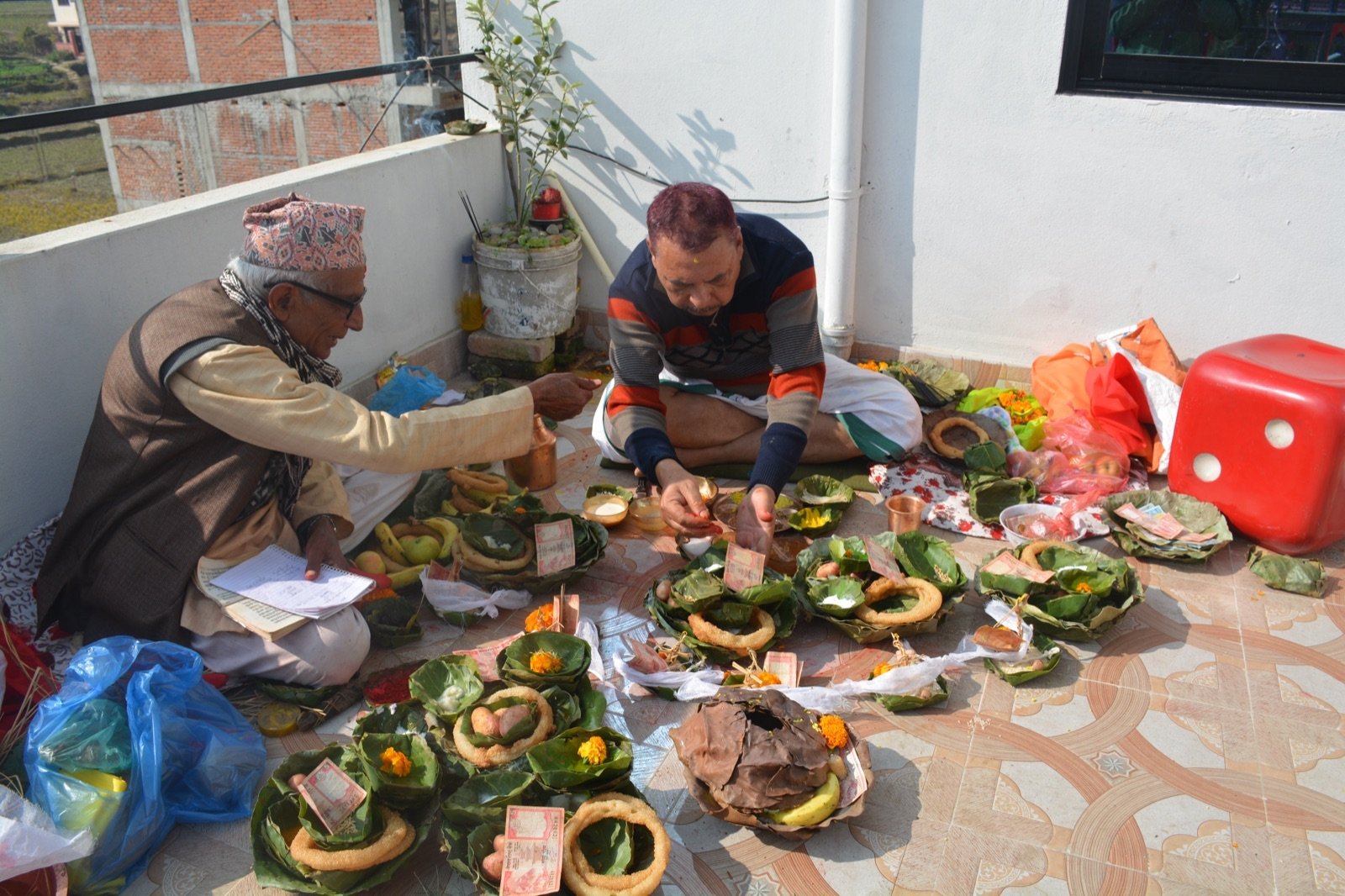
Photo: "A man and a Brahmin performing Shraddha ceremony in Nepal" by 9n2nk, CC BY-SA 4.0, via Wikimedia Commons
Every year, for a fortnight in the Hindu lunar calendar, millions of families across India pause their daily routines to remember those who came before them. This period — Pitru Paksha — is dedicated entirely to honouring one's ancestors through Shraddha, Tarpan, and Pind Daan. For many families, it is one of the most emotionally significant observances of the year, rooted in the belief that a family's peace, harmony, and prosperity are deeply connected to how well it remembers and nourishes its Pitrs (departed ancestors).
What Is Pitru Paksha?
Pitru Paksha is a sixteen-lunar-day period that begins on Bhadrapada Purnima (the full moon of the Hindu month of Bhadrapada) and ends on Ashwin Amavasya, the new moon day also known as Sarva Pitru Amavasya or Mahalaya Amavasya. In the Gregorian calendar, this usually falls between mid-September and early October.
During these sixteen days, each day corresponds to a specific lunar date (Tithi). Families perform Shraddha on the Tithi that matches the date on which their ancestor passed away. If the exact Tithi is not known, or if a family wishes to honour all ancestors collectively, the rituals are performed on Sarva Pitru Amavasya — the final and most significant day of the fortnight.
The Significance of Shraddha and Tarpan
Hindu scriptures describe three debts (Rinas) that every individual is born with — Deva Rin (debt to the gods), Rishi Rin (debt to sages and teachers), and Pitru Rin (debt to one's ancestors). Pitru Paksha is the period set aside to honour and repay this Pitru Rin.
Shraddha refers to the ritual offering performed with faith and devotion to nourish the ancestors residing in Pitru Loka. Tarpan is the accompanying water ritual, in which water mixed with black sesame seeds (til) and barley is offered, usually facing south, while reciting the names and gotra of one's forefathers.
"पितरः प्रीयन्ते तेषां श्राद्धेन विधिपूर्वकम्।" — When Shraddha is performed with proper devotion and ritual, the ancestors are pleased and bestow their blessings upon the family.
Many families believe that when Pitru Rin remains unfulfilled — due to neglect, an incomplete last rite, or an unfulfilled wish of the departed — it can manifest as Pitru Dosha, which is said to bring recurring obstacles in family life, delays in marriage, health concerns, or a general lack of peace at home. Performing Shraddha with sincerity during Pitru Paksha is considered one of the most effective ways to address this.
Rituals Performed During Pitru Paksha
- Pind Daan — an offering of rice balls (Pind) mixed with til and ghee, symbolically representing a subtle body for the ancestor and offered with prayers for their liberation (moksha).
- Panchbali — five small food offerings made before the family meal each day, to a cow, a dog, a crow, ants/insects, and other unseen beings, each carrying its own symbolic meaning.
- Brahmin Bhoj — feeding Brahmins, Purohits, or those in need in the name of one's ancestors, considered equivalent to feeding the Pitrs themselves.
- Mahalaya Amavasya rituals — the concluding day of Pitru Paksha, when Shraddha is performed for all ancestors, especially those whose exact death Tithi is unknown.
| Panchbali Offering | Symbolic Significance |
|---|---|
| Cow (Go Bali) | Regarded as sacred and a medium that carries the offering to the ancestors |
| Dog (Shwan Bali) | Believed to be a guardian associated with Yama, the deity of death |
| Crow (Kaak Bali) | Traditionally considered a messenger through which ancestors accept the offering |
| Ant/Insects (Pipilika Bali) | Represents compassion towards the smallest and most vulnerable forms of life |
| Other Beings (Deva Bali) | An offering to unseen beings and deities present in the household |
Do's and Don'ts During Pitru Paksha
| Do's | Don'ts |
|---|---|
| Perform Tarpan and Shraddha on the ancestor's Tithi | Avoid starting new ventures, purchases, or auspicious ceremonies |
| Feed Brahmins, Purohits, and the needy | Avoid non-vegetarian food and alcohol on the day of the ritual |
| Offer food to crows, cows, and dogs daily | Avoid conflicts, harsh words, or negativity at home |
| Maintain cleanliness, simplicity, and discipline | Avoid haircuts or shaving, as observed in many family traditions |
| Recite Pitru Stotram or Gita Path with devotion | Avoid skipping the rituals even when short on time — a simple Tarpan is considered better than none |
Frequently Asked Questions
What if we don't know the exact date our ancestor passed away?
In such cases, the Shraddha can be performed on Sarva Pitru Amavasya (Mahalaya Amavasya), the last day of Pitru Paksha, which is dedicated to all ancestors regardless of their individual death Tithi.
Can women perform Shraddha rituals?
Traditionally, the eldest son performs the primary rites, but practices vary widely by region and family tradition. In the absence of a son, daughters, other close family members, or a Purohit-guided ceremony on the family's behalf are commonly accepted alternatives.
Is it necessary to travel to Gaya, Haridwar, or another Tirtha Sthal?
It is not mandatory. While pilgrimage sites such as Gaya are considered especially auspicious for Pind Daan, the rituals can be performed with equal devotion at home or through a qualified Purohit, in line with the family's tradition and convenience.
Book Your Pitru Paksha Shraddha with DevPitra
DevPitra connects you with experienced, verified Purohits who can guide and perform Shraddha, Tarpan, and Pind Daan for your family — at home or through a live online ceremony — with complete adherence to Vedic tradition.